Dry Rot - An Overview
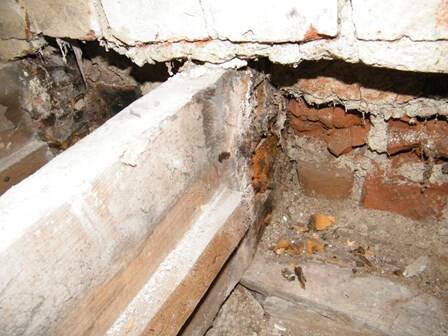
Dry rot is the term given to brown rot decay caused by certain fungi that deteriorate timber in buildings and other wooden constructions without an apparent source of moisture. The term is a misnomer because all wood decaying fungi need a minimum amount of moisture before decay begins. The decayed wood takes on a dark or brown crumbly appearance, with cubical like cracking or checking, that becomes brittle and can eventually crush the wood into powder. Chemically, wood attacked by dry rot fungi is decayed by the same process as other brown rot fungi. An outbreak of dry rot within a building can be an extremely serious infestation that is hard to eradicate, requiring drastic remedies to correct. Significant decay can cause instability and cause the structure to collapse.
The Dry Rot life cycle
The life-cycle of dry rot consists, interestingly, of four main stages (beetles life cycle's coincidentally also consist of 4 stages)
- Dry rot begins as a microscopic spore which, in high enough concentrations, can resemble a fine orange dust.
- If the spores are subjected to sufficient moisture, they will germinate
- White coloured strands commonly known as 'fingers' are often seen. These 'fingers' are scientifically known as hyphae. As the hyphae grow they will eventually form a large mass known as mycelium.
- The final stage is a fruiting body which pumps new spores out into the surrounding air, and the cycle repeats.
We do not agree with nor believe in chemival treatmets: We really do struggle to udertand why people today think that expensive, harmful, man made chemicals are needed to deal with an issue created by Nature? Without doubt 'Mark Eting' has infiltrated peopes brains again?
Our Motto is: "FIND THE CAUSE, FIX THE CAUSE" and was formed by many decades of working with, not against, nature.
The cause is prolonged exposure to/water / moisture - that's the cause, so fix it!
What are the most important points requiring the need for professional help?
Dry rot thrives in moist conditions, moisture control and adequate ventilation are paramount.
Professional help may be needed to identify the source of moisture/ assess the extent of the damage, and implement effective treatment strategies/timber repairs to prevent recurrences.
The dry rot fungus "hyphae" (fingers)can and will 'climb' up brickwork and plasteerwork, so Ignoring dry rot can and usually does lead to significant structural problems and costly repairs.
There is a very good reason why our Motto is not: "find the cause, then run away & bury your head in the sand, and just pretend it's not real"
There are many chemicals on sale today which can be bought and used by anyone, but allowing unknowledgeable and inexperienced persons to store, use, and handle commercial grade chemicals with no formal prior training is frankly not only very irresponsible of Mark Eting, but also potentially dangerous, in our opinion.
What does dry rot look like?
Dry rot can manifest in various ways, including timber that appears shrunken, cracked, and a dull brown colour. You may also notice fungal growths, such as cotton wool-like mycelium, fruiting bodies (sporophores), or strands (hyphae) spreading across surfaces. A musty, damp odour is also a common indicator.
Moisture and fungal growths
Dry rot is caused by a specific fungus kmow as Serpula lacrymans, which requires moisture to thrive. Addressing moisture sources is crucial to preventing and treating dry rot. Look for signs of leaks, condensation, or damp, and take steps to rectify these issues promptly.


Our finishing points
- Dry rot is the term given to brown rot decay caused by certain fungi that deteriorate timber in buildings and other wooden constructions, often without an apparent source of moisture. however:
- All wood decaying fungi need a minimum amount of moisture before decay begins.
- The decayed wood takes on a dark or brown/crumbly appearance, with cubical like cracking.
- The crack8ng becomes brittle and can eventually crush the wood into powder.
- Chemically, wood attacked by dry rot fungi is decayed by the same process as other brown rot fungi.
- An outbreak of dry rot within a building can be an extremely serious infestation that is hard to eradicate, requiring drastic remedies to correct.
- Significant decay can cause instability and cause the structure to collapse.