

Is Lining paper more than meets the eye these days?
Have you ever wondered about the history of lining paper, especially when plastic became part of the mix? We have, so we explored how this seemingly simple material has evolved and what that means for your walls. Join us as we uncover the secrets of lining paper and its impact on traditional buildings.

The unexpected evolution of lining paper
When did wood pulp paper get mixed with plastic? This question is vital for anyone dealing with period properties. The addition of plastic has significantly changed how lining paper behaves, affecting its moisture vapour permeability and suitability for historic walls, where moisture egress is more important to moisture ingress. Understanding this transformation is crucial for proper conservation and restoration.
Papermakers, for many years, have tried very hard to exclude meltable plastics such as polyethylene from the stock supplied to their process. Thermoplastic materials can easily adhere to drying cylinders and calender stacks of a paper machine, thus damaging the efficiency of the process.
Though observation these days suggests that lower costs in comparison to a conventional papermaking means more profits! These allegations really do need further examination, but the type of wood-pulp papers we used half a century ago are very different to what we are seeing in today's capitalist world.
Think:
Soaking and expansion times: key considerations
Thermoplastics are polymers composed of long linear or slightly branched chains that are held together by relatively weak intermolecular forces such as Van Der Waals forces, and Hydrogen Bonds rather than the covalent bonds between chains. When heated thee forcesweaken which allows the 'chain links' to move past one another
This makes the material pliable and mouldable.
Upon cooling the chain links then lock back into place and solidify the material.
The properties of lining paper, particularly its soaking times and expansion rates, are obviously questionable by the presence of plastic.
This affects how the paper adheres to walls, its long-term durability, and subsequent removal (soaking/steming).
We believe everyone, from homeowners to professionals, should understand what appear to be, be the becoming nuances.
If not, why then these days, do We have to buy 'special' adhesives for "paper" - when We never had to before?
Evolution is now Devolution.
Breathability and springing edges
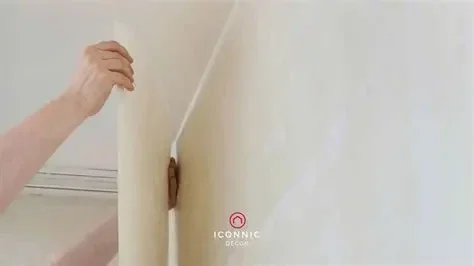
Modern lining paper often lacks the natural breathability, crucial for historic buildings, trapping moisture and potentially leading to issues like mould or damp. Furthermore, We found that the plastic content contributes to edges springing away from the wall after application.
- But of course, Amchair Experts only use lining paper because they think it wasgesigned and made especially for their laziness! READ MORE HERE 🤣🤣
Think 👍